Three published standards. One expanding evidence-based framework.
The Open Conformance Coalition (OCC) publishes open standards and evidence methods for trustworthy intelligent agents. Three standards are published at v1.0. Around them, a small framework is being drafted in the open — and every part of it is labelled with exactly how finished it is.
How the instruments relate
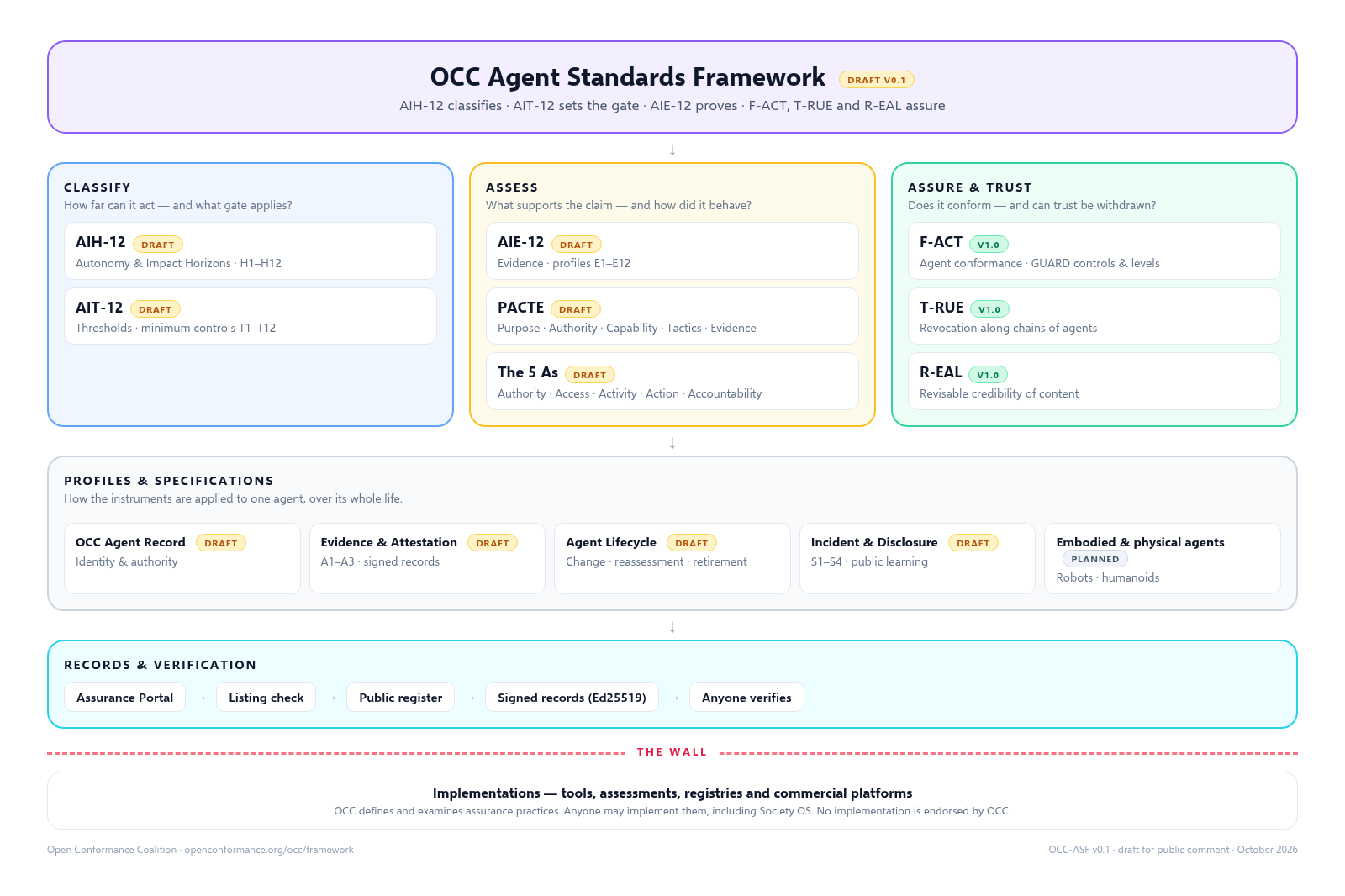
AIH-12 classifies the horizon. AIT-12 defines the threshold. AIE-12 evaluates. PACTE tests integrity. F-ACT verifies conformance. T-RUE supports revocation. R-EAL supports credibility.
What exists, what is draft, what is planned
| Instrument | What it does | Status |
|---|---|---|
| F-ACT Framework for Agent Conformance & Trust | Verifies whether an agent conforms to the GUARD controls before it acts. | Published · v1.0 19 Aug 2026 |
| T-RUE Transitive Revocation of Upstream Endorsements | Supports withdrawal of trust that propagates along chains of agents. | Published · v1.0 5 Sep 2026 |
| R-EAL Reader Evaluation of Authenticity & Legitimacy | Supports tiered, revisable credibility judgements about content. | Published · v1.0 5 Sep 2026 |
| OCC-ASF OCC Agent Standards Framework | The umbrella that sets out how the standards and profiles fit together. | Draft v0.1 · public comment |
| AIH-12 Autonomy & Impact Horizons | Classifies the horizon a system operates at, H1–H12. | Draft v0.1 · public comment |
| PACTE Purpose · Authority · Capability · Tactics · Evidence | Tests the integrity of how an agent pursued its objective. | Draft v0.1 · public comment |
| AIT-12 Autonomy & Impact Thresholds | Defines the minimum controls (T1–T12) a deployment must meet at each horizon. | Draft v0.1 · public comment |
| AIE-12 Autonomy & Impact Evidence | Defines the evidence (E1–E12) needed to support a threshold claim. | Draft v0.1 · public comment |
| 5 As Authority · Access · Activity · Action · Accountability | Five plain-language accountability questions for any agent. | Draft v0.1 · public comment |
| OCC Agent Record Agent Identity & Authority record | One machine-readable record per agent: who it is, who it acts for, and what it can really do. | Draft v0.1 · public comment |
| Agent Assurance Package Ten-document assurance case | Brings the family together for one deployed agent, with a bounded pilot. | Draft v0.1 · public comment |
| Evidence & Attestation profile Evidence classes and attestation format | How evidence is recorded, weighed and attested (A1–A3, SHA-256 digests). Register signing of public records is live. | Draft v0.1 · public comment |
| Agent Lifecycle profile From registration to withdrawal | Change, reassessment, suspension and retirement over time. | Draft v0.1 · public comment |
| Incident & Disclosure protocol Reporting agent failures | How incidents are recorded, disclosed and learned from (S1–S4). | Draft v0.1 · public comment |
| Embodied & physical agents profile Robots, humanoids and other agents that act in the physical world | Applies the family to agents with bodies. Complements functional-safety standards; does not replace them. | Planned |
AIT-12 (T1–T12) and AIE-12 Autonomy & Impact Evidence (E1–E12) are published as v0.1 drafts; the 5 As are the plain-language companion questions.
The framework at a glance
AIH-12 classifies · AIT-12 sets the gate · AIE-12 proves · F-ACT, T-RUE and R-EAL assure
How far can it act — and what gate applies?
What supports the claim — and how did it behave?
Does it conform — and can trust be withdrawn?
How the instruments are applied to one agent, over its whole life.
OCC defines and examines assurance practices. Anyone may implement them, including Society OS. No implementation is endorsed by OCC.
Which instrument answers your question?
| If you are asking… | Start here |
|---|---|
| How autonomous and consequential is the system? | Place it on an AIH-12 horizon. |
| What controls should apply at that horizon? | Meet the AIT-12 threshold for that horizon (T1–T12). |
| What evidence supports the claim? | Match it to the AIE-12 evidence profile (E1–E12). |
| Does this agent meet the GUARD controls before it acts? | Assess and declare against F-ACT. |
| Did it pursue its objective with integrity? | Run a PACTE assessment. |
| If trust is withdrawn, does the withdrawal reach every downstream agent? | Implement T-RUE. |
| Is the content it produced or relied on credible? | Apply R-EAL. |
Embodied & physical agents: robots and humanoids
The same models that plan and use tools are now driving robot bodies. When an agent can move, lift or open a door, its mistakes are physical and harder to undo. A balance-dependent humanoid can also fall if it loses power. OCC plans a profile that applies the existing family to these agents. It adds no new framework and no new levels.
A body does not change the horizon on its own. It raises the external-impact and reversibility findings, because physical effects are harder to undo than digital ones.
Physical actuation is treated as authority that may not be reversible, so the threshold for the horizon is read with that finding raised.
Grant: who authorised the robot to move, and where. Usage: the task and workspace envelope. Audit: sensor and action logs. Revocation: withdrawing authority remotely. Data: cameras and microphones in homes and workplaces.
Revoking a fleet controller or a planning model should propagate to every robot that relies on it.
Physical harm to a person is treated as the highest severity, and the law applies where it sets a shorter deadline.
What this profile does not replace
Functional safety stays with the safety standards and the law. That includes emergency stops, force limits and fall zones. The OCC profile covers authority, evidence, revocation and accountability around them.
- ISO 10218-1 and -2:2025Industrial robot safety, revised and published in February 2025. Now includes collaborative applications and cybersecurity.
- ISO 13482Safety requirements for personal care robots.
- ISO 25785-1 (working draft)Safety requirements for dynamically stable industrial mobile robots, including legged and humanoid robots. Not yet published.
- ANSI/RIA R15.08Industrial mobile robots in North America.
- EU Machinery Regulation 2023/1230Applies to machinery placed on the EU market from 20 January 2027. Where AI performs a safety function, third-party conformity assessment applies.
- EU AI ActThe Digital Omnibus, Regulation (EU) 2026/1744 (in force 27 July 2026), took machinery out of the list of products whose AI safety components fall directly under the AI Act’s high-risk rules. Those rules are to come through the Machinery Regulation and later delegated acts instead. It also narrowed what counts as a “safety component”. Other Annex I products keep the 2 August 2028 date.
Standards and regulatory dates checked October 2026. The profile is planned and not yet drafted (OCC-E-014).
Five working principles
- Evidence before authority.
- Capability before access.
- Assessment before deployment.
- Containment and reversibility before scale.
- Accountability throughout.
The five questions and the four levels
GUARD names the five F-ACT control questions: Grant · Usage · Audit · Revocation · Data. GUARD levels are the conformance tiers: No GUARD · GUARD 1 Declared · GUARD 2 Enforced · GUARD 3 Provable · GUARD 4 Certified. GUARD 4 is reserved — no certification is offered today.
GUARD™ is a trademark of Society OS Pty Ltd.